Gentle Discipline vs. Punishment: How to Set Boundaries That Build Kids' Self-Esteem

"Not right now.""It's time to put the tablet away.""Please don't speak that way."
How many times have we felt guilty saying these words to our children?
Many parents worry that setting boundaries will upset their child or damage their relationship with them. Others believe that discipline means being strict or punitive. In reality, healthy boundaries should never push children away. When communicated with love, respect, and consistency, they help children feel safe, secure, and understood.
Discipline is not about controlling children. It is about helping them learn to regulate themselves.
Why Do Children Need Boundaries?
Children are not born knowing how to manage their emotions, control their impulses, or navigate social relationships. Boundaries serve as a safe guide that teaches them:
- what is acceptable
- what is unsafe
- how to treat others with respect
- how to take responsibility for their actions
Just as guardrails on a bridge don't limit our freedom but protect us, boundaries give children the confidence to explore the world safely.
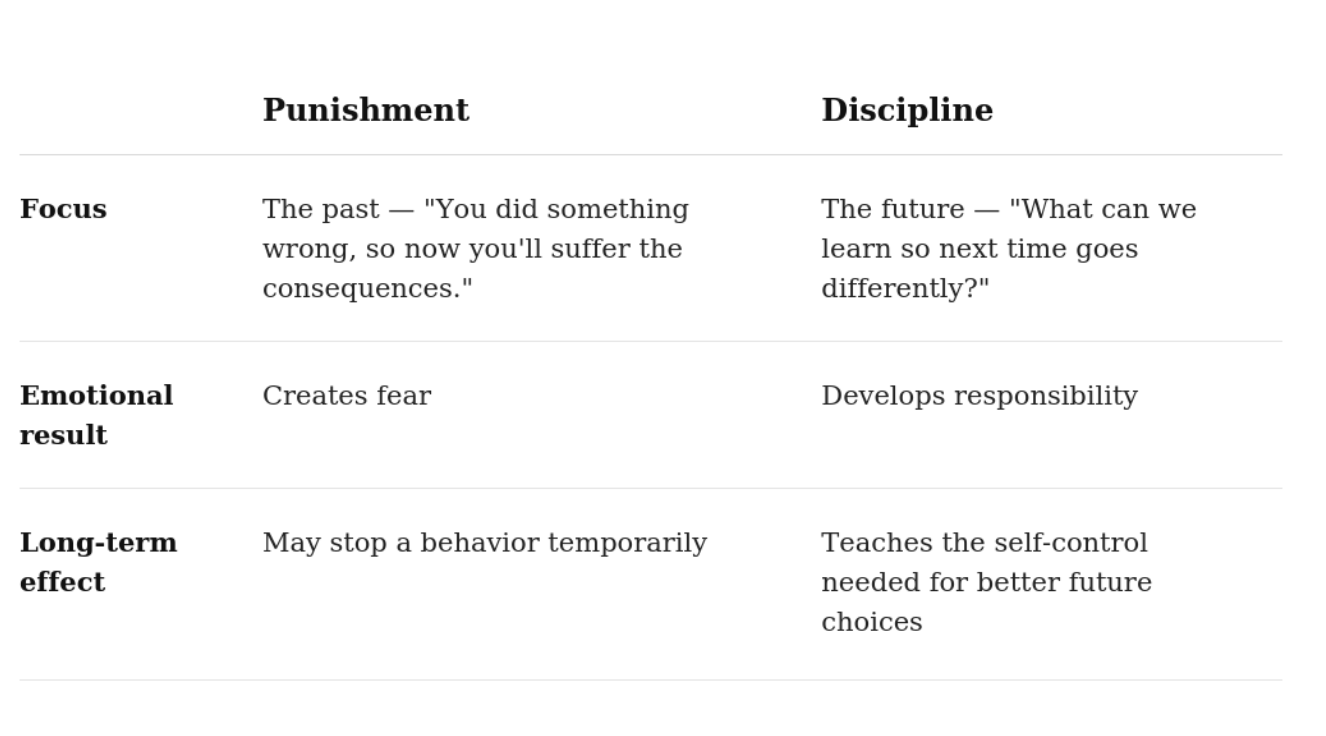
Is Discipline the Same as Punishment?
No. Discipline and punishment are often confused, but they are fundamentally different.
Why Do Children Keep Testing Boundaries?
Many parents ask: "If my child knows the rule, why do they keep breaking it?"
The answer is simple. Children are not necessarily trying to challenge or manipulate us. They test boundaries because they:
- seek safety
- want to know whether rules are consistent
- are still developing self-control
Every time a parent calmly and consistently maintains a boundary, the child learns that they can rely on them.
Can You Set Boundaries With Firmness and Empathy?
YES, understanding a child's feelings does not mean changing the rule. We can validate emotions without accepting inappropriate behavior.
For example, instead of saying: "Stop crying." Try saying: "I understand you're upset because playtime is over. It's hard to stop doing something you enjoy. Even so, it's time for bed now."
The child feels heard and understood, while the boundary remains clear.
Do Natural Consequences Work Better Than Punishment?
Consequences are most effective when they are directly connected to the behavior. For example:
- If a child draws on the wall, they help clean it.
- If they throw their toys, they pick them up before starting another activity.
- If they take too long to get ready, they may have less time at the playground.
By contrast, unrelated punishments, like "No TV for a week", often create frustration without helping children understand how they can make a different choice next time.
Is It Normal for My Child to React Badly to a Boundary?
Yes. It is perfectly normal for children to become upset when they hear "NO". A strong emotional reaction does not mean the boundary was wrong, it means the child is learning to cope with disappointment, a life skill that takes time to develop! Our role as parents is not to eliminate every difficult emotion. It is to help children tolerate and manage those emotions in a healthy way.
4 Common Mistakes Parents Make When Setting Boundaries
- Changing our mind because the child insists. When "no" eventually becomes "yes," children learn that persistence can change the rules.
- Raising our voice. Yelling may stop a behavior temporarily, but it does not teach emotional regulation. Children learn much more from the way we manage our own emotions than from the volume of our voice.
- Having too many rules. When everything is important, eventually nothing is. Focus on the few rules that truly matter: safety, respect, responsibility.
- Being inconsistent. Children thrive on predictability. A rule that only applies "sometimes" creates confusion and insecurity.
How Do Boundaries Build Self-Esteem?
Self-esteem is not built by constantly hearing "Good job." It grows when children feel that:
- they are loved even when they make mistakes
- their parents believe in their abilities
- they are trusted to take responsibility
- mistakes are opportunities to learn
When we say: "I believe you can fix this," we send a powerful message: "You are capable. Your mistake does not define who you are."
Phrase Swaps: What to Say Instead
Instead of... "Why are you so careless?" try "What could we do differently next time?"
Instead of... "If you don't stop, you'll be in trouble!" try "Do you remember what our family rule is?"
Instead of... "I'm disappointed in you." try "What you did wasn't the right choice. Would you like us to fix it together?""
Instead of..."You're a bad child." try "You made a choice that wasn't the right one. That doesn't change how much I love you."
Create Family Rules Together
Children are much more cooperative when they feel their opinions matter. Sit down together and agree on a few simple, clear family rules. For example we speak respectfully, we solve conflicts without hurting others, we tidy up after ourselves, we tell the truth, we help one another!
When children participate in creating the rules, they are much more likely to follow them.
The Bottom Line
Boundaries are not a sign of strictness. They are a sign of love. Every time a parent remains calm, consistent, and emotionally available, they send their child a powerful message: "I'm here to guide you, not to control you."
Children do not need perfect parents. They need parents who can say "no" with kindness, listen with empathy, and stay by their side through difficult moments. Because, in the end, the strongest boundaries are not those enforced through fear, they are the ones built on trust, consistency, respect, and unconditional love.
If you'd like to practice these phrase swaps in real parenting scenarios, with real-time feedback, not just theory, we walk through them live in our free webinars targeting parents with children 3-17 years old [Save your spot for the next one → here]